
By Tendai Keith Guvamombe
Ghana’s agricultural sector, a cornerstone of the national economy that employs approximately 45% of the total workforce and contributes roughly 20% to the Gross Domestic Product, is currently facing an existential threat from climate change (IntechOpen, 2026). Because the sector is overwhelmingly rain-fed—with only about 2% of agricultural land under irrigation—any shift in weather patterns directly translates into production losses (IntechOpen, 2026). Recent data indicates that maize yields in Ghana have already declined by 5% to 25% due to these climatic shifts (IntechOpen, 2026).
The impact manifests through increasingly erratic rainfall, prolonged droughts, and rising temperatures. In the northern regions, farmers report frequent windstorms and extreme heat that not only damage standing crops but also destroy post-harvest storage facilities, leading to significant spoilage and price volatility (MDPI, 2023). Projections for the coming decades are even more concerning: temperatures in Ghana are expected to rise by 1.02°C by 2040 and 1.8°C by 2080, potentially pushing staple crops like maize beyond their heat-tolerance thresholds during critical pollination stages (Frontiers, 2026; IntechOpen, 2026).
Beyond staples, the cocoa industry—a vital export earner—is equally vulnerable. Research indicates that historical variations in rainfall and temperature have accounted for over 56% of the variations in cocoa output (UGSpace, 2026). Climate-induced stress also triggers secondary socio-economic crises, such as the migration of pastoralists into farming communities in search of water and grazing land, which often results in violent land-use conflicts (Taylor & Francis, 2026).
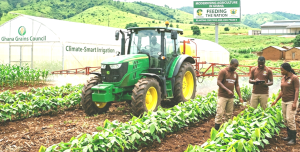
To combat these challenges, the Ghanaian government and international partners have introduced “Climate-Smart Agriculture” (CSA) and the Resilience against Climate Change (REACH) project (Frontiers, 2026). These initiatives encourage smallholders to adopt conservation agriculture practices, such as minimal tillage, crop rotation, and the use of improved, heat-resistant cultivars (Frontiers, 2026; Taylor & Francis, 2026). However, the success of these adaptations remains constrained by a lack of access to finance and reliable climate information services for the country’s most remote farming communities (IntechOpen, 2026).
References
Frontiers. (2026). Conservation agriculture as a response strategy to climate change in resource-scarce settings in North Western Ghana. Frontiers in Sustainable Food Systems. https://doi.org/10.3389/fsufs.2026.1802248
IntechOpen. (2026). Risk averse smallholder agri-food system: Exploring climate change adaptation options to inform planning and policy in Ghana. IntechOpen. https://doi.org/10.5772/intechopen.1197606
MDPI. (2023). Climate and food insecurity risks: Identifying exposure and vulnerabilities in the post-food production system of northern Ghana. Land, 12(11), 2025. https://doi.org/10.3390/land12112025
Taylor & Francis. (2026). Factors influencing climate change adaptation by smallholder farmers in the Talensi district of Ghana. Agroecology and Sustainable Food Systems. https://doi.org/10.1080/21683565.2026.2660106
Taylor & Francis. (2026). Climate-induced stress, migration and the escalation of farmer-herder conflicts in Sub-Saharan Africa: A systematic review. Cogent Social Sciences. https://doi.org/10.1080/23311886.2026.2646711
UGSpace. (2026). Climate variability and cocoa production: The implications of micro-adaptation measures on cocoa farmers’ income. University of Ghana. https://ugspace.ug.edu.gh/items/164470a9-e6c6-4adb-bccd-6c5a8f10c054