By Tendai Guvamombe
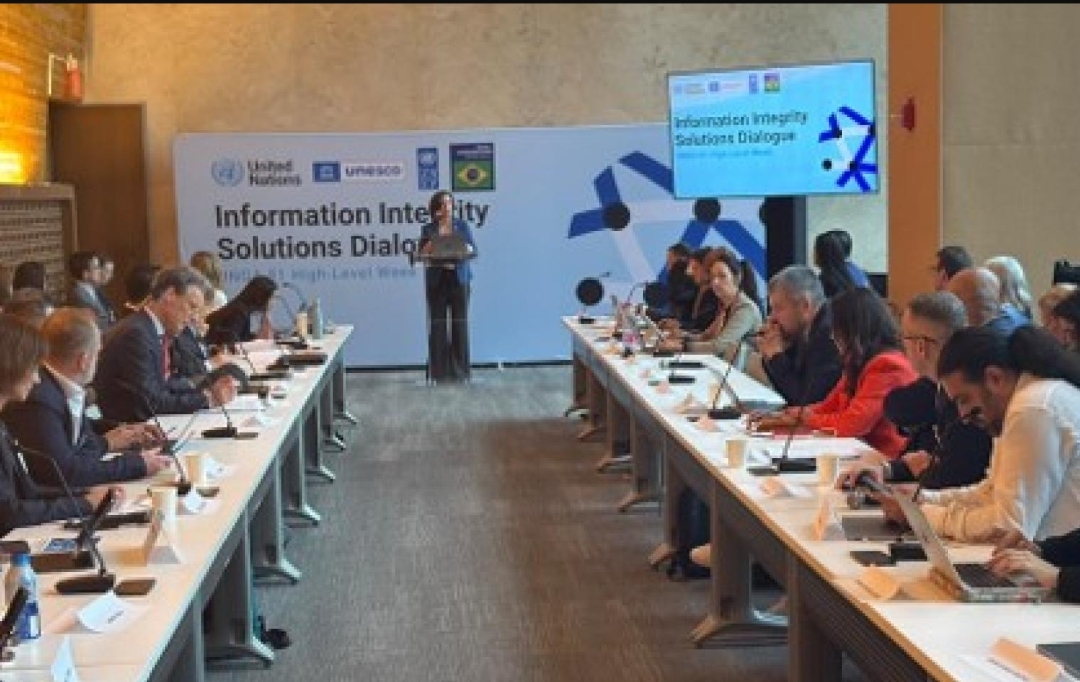
The Ambassador of the Republic of Cameroon to the Federal Democratic Republic of Ethiopia and Permanent Representative to the African Union and the United Nations Economic Commission for Africa (UNECA), H.E. Churchill Ewumbue-Monono participated in a high-level side event on the Information Integrity Solutions Dialogue: “From Global Principles to Collective Action,” held on the margins of the 81st Session of the United Nations General Assembly (UNGA81) in New York.
The event was jointly organized by the United Nations Department of Global Communication (DGC), United Nations Development Program (UNDP), United Nations Educational, Scientific and Cultural Organization (UNESCO) and the Government of Brazil, with the participation of Mrs. Esther Azaa Yambou Tankou, Head of the Media and Information Division, AUC, and Communication Adviser to the Permanent Observer Mission of the African Union to the United Nations, and Mr. Omar Faruk, President of the Federation of African Journalists (FAJ).
During the discussion, Ambassador Ewumbue – Monono provided updates on the AU Peace and Security Council (AUPSC) meeting held on November 14, 2025, under Cameroon’s leadership, emphasizing the importance of information integrity and media sovereignty in Africa. The Cameroon Ambassador further announced that, under Cameroon’s chairmanship, the AUPSC will deliberate on “Information Integrity, Peace and Security in Africa” on October 9, 2026.
It is worth noting that Media sovereignty enables countries, the African Union and regional institutions to shape information policies according to their own legal frameworks, cultures, and security needs. This can help strengthen information integrity by supporting local journalism, accountable regulation, and protection against foreign manipulation.
However, if sovereignty is used to restrict independent media or control narratives, it can undermine integrity by encouraging censorship and misinformation. Effective collective action, therefore, requires balancing national authority with transparency, media freedom, independent fact-checking, cross-border cooperation, and shared standards.
Information integrity on the international stage refers to ensuring that information shared across borders is accurate, reliable, transparent, independent, and resistant to manipulation.
Furthermore, on the international scene, information integrity is essential for peace, democratic governance, public trust, and collective security. It requires cooperation among governments, international organizations, media outlets, technology companies, civil society, and journalists to:
- Counter disinformation, misinformation, and foreign interference.
- Protect independent journalism and freedom of expression.
- Promote media and digital literacy.
- Strengthen fact-checking and responsible platform governance.
- Improve transparency in artificial intelligence and online communications.
- Develop shared international standards while respecting national sovereignty and human rights.
Cooperation among governments, journalists, researchers, civil society, educators, and technology companies can enhance public trust by sharing experience where researchers provide evidence, journalists verify claims, and technology platforms help identify coordinated manipulation. Increasing transparency can help institutions gather and check information, and with coordinating rapid responses, partners can quickly address false claims with consistent, accessible corrections, while cooperation can counter harmful misinformation without suppressing legitimate disagreement.
“Trust grows when people see that information is evidence-based, transparent, independently scrutinized, and responsive to public concerns”, stated the Head of Media and Information Division at the Directorate of information and Communication of the African Union.