
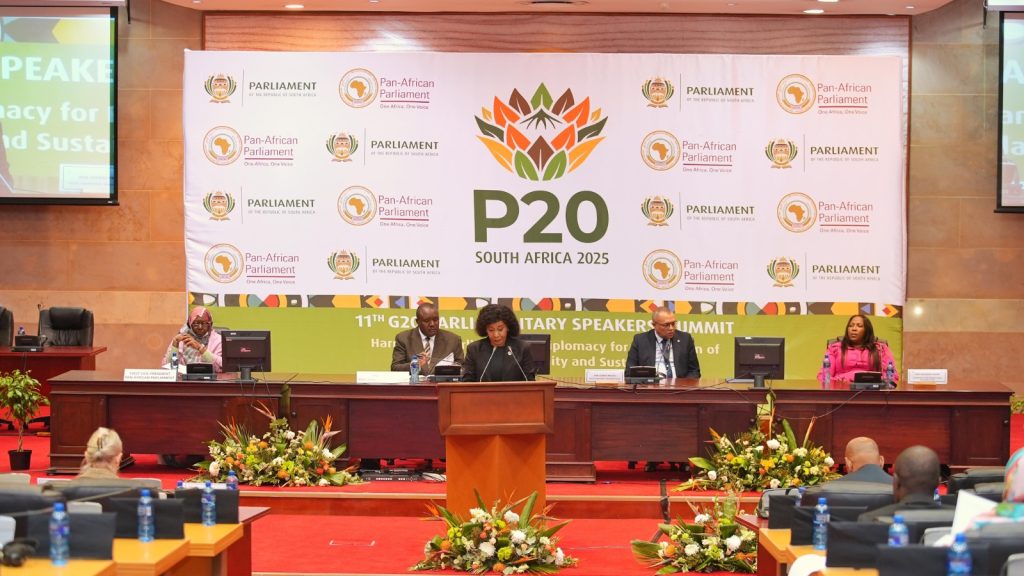
MIDRAND, SOUTH AFRICA – As South Africa takes the helm of the G20 Presidency, a joint workshop held today by the Pan-African Parliament (PAP) and the Parliament of the Republic of South Africa underscored the critical imperative of leveraging this platform to champion the continent’s priorities.
Under the theme, “Harnessing Parliamentary Diplomacy for the Realization of Global Solidarity, Equality and Sustainability,” the workshop sought to galvanize African parliamentarians and solicit their vital input into South Africa’s G20 agenda.
H.E. Chief Fortune Charumbira, President of the Pan-African Parliament, emphasized that South Africa, as the only African member of the G20, bears the hopes and aspirations of an entire continent.
“Its presence is far more than symbolic; it is, in fact, strategic,” he asserted. South Africa has historically used this forum to advocate for equitable global economic reform, climate finance justice, investment in African infrastructure, and the promotion of African solutions to African challenges, particularly in food security, health, and digital transformation.
The workshop highlighted the indispensable role of the Pan-African Parliament in this endeavor. PAP is tasked with unifying African voices, informing South Africa’s G20 agenda through debate and resolutions, and ensuring inclusivity by engaging diverse voices from across the continent, including youth, women, and civil society.
Crucially, PAP will hold South Africa accountable to African priorities such as Agenda 2063, the African Continental Free Trade Area (AfCFTA), and the UN Sustainable Development Goals (SDGs).
Chief Charumbira stressed that through its advisory, oversight, and legislative mandate, PAP can ensure Africa is not merely represented, but “respected, heard, and influential” in areas like Trade Justice, Climate Resilience and Adaptation, and Ethical Resource Governance.
This includes channeling grassroots concerns from smallholder farmers, advocating for climate justice, and addressing illicit financial flows that drain Africa’s resources.
To solidify this continental mandate, a “Continental Compact” was proposed, envisioning structured consultations between PAP and South Africa’s G20 delegation, an African G20 advisory council, and periodic briefings.
Such mechanisms, it was argued, would enhance legitimacy and policy alignment, ensuring a people-centered G20 engagement strategy.
The workshop concluded with a powerful call for Africa to “take its place on the global governance stage not as a recipient of policy, but as a partner in shared prosperity, peace, and progress.”
South Africa’s G20 Presidency represents a pivotal opportunity for a unified African voice to shape global decisions that directly impact the continent’s future.