
By Caroline Washaya-Moyo
HARARE — Air Zimbabwe has significantly reduced its financial losses and is now being challenged to build on the gains by reclaiming lost market share and expanding its route network beyond regional destinations into intercontinental skies.
The national airline’s revenue increased by 42.6 percent from US$7.54 million to US$10.74 million in 2024, while its net loss narrowed by 31.7 percent from US$10.44 million to US$7.12 million.
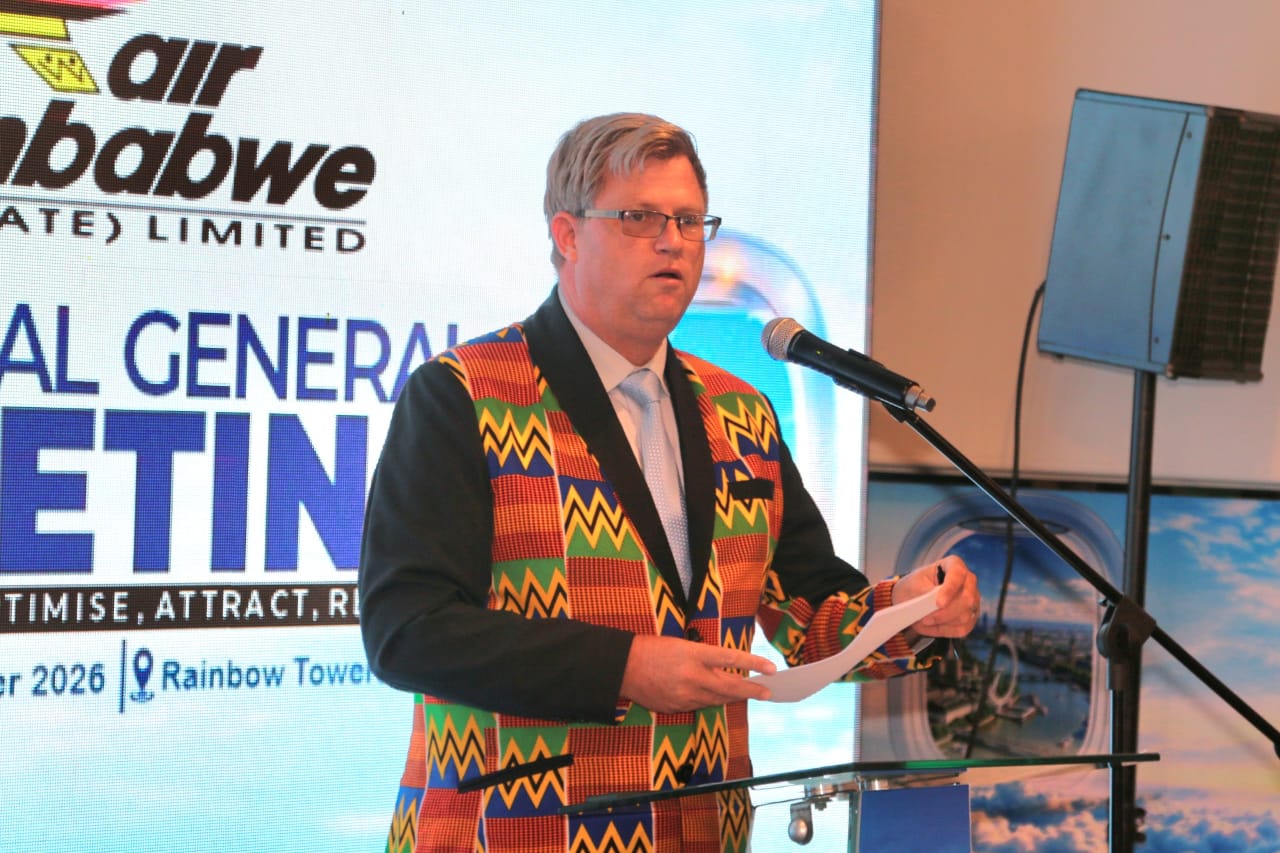
Deputy Minister of Transport and Infrastructural Development Honourable Joshua Sacco said the improved financial performance should now provide a foundation for accelerating the airline’s commercial turnaround.
“As the market opens up for business, tourism and travel, let Air Zimbabwe step up, make its mark and regain its lost market share, expanding its route network further into intercontinental skies,” he said.
He was speaking at the 4th Annual General Meeting of Air Zimbabwe, where shareholders considered the audited financial statements for the year ended 31 December 2024.
The financial results also showed a strengthening of the airline’s balance sheet, with total assets increasing to US$89.85 million and shareholders’ equity rising to US$40.31 million.
The gross loss was also substantially reduced, reflecting the impact of cost containment and operational efficiency measures implemented under the airline’s turnaround programme.
However, Government has stressed that reducing losses is only one stage of the recovery process, with the ultimate objective being sustainable profitability, positive cash generation and reduced dependence on shareholder support.
This will require continued commercial discipline, prudent expenditure, stronger revenue management and close attention to route and fleet economics.
Cargo emerges as a growth area
Air Zimbabwe’s cargo business recorded particularly strong growth during the year, with overall cargo volumes increasing by 59.4 percent and regional cargo rising by more than 101 percent.
The performance highlights the potential for cargo to become a more important component of the airline’s business model and revenue base.
Government has encouraged the airline to further develop this segment, particularly in supporting the movement of agricultural produce, tourism-related products and other commercial goods within Zimbabwe and across the region.
The airline transported 33,676 passengers in 2024, connecting Zimbabwean cities with regional destinations including Johannesburg and Dar es Salaam, while maintaining domestic connectivity to Victoria Falls and Bulawayo.
Despite these operations, the passenger load factor of approximately 46 percent remains a key area requiring attention.
Improving passenger numbers will require greater fleet availability, stronger route economics, improved distribution systems, enhanced customer experience, digital platforms and strategic commercial partnerships.
Governance reforms underpin turnaround
The financial improvements have been accompanied by significant changes in the airline’s governance and institutional framework.
Following Air Zimbabwe’s transition into the oversight of the Mutapa Investment Fund under Statutory Instrument 156 of 2023, the airline entered a new phase of governance and investment oversight.
The reform is aligned with Government’s broader policy of ensuring that State-owned and strategic entities operate with greater accountability, professionalism, commercial discipline and clear performance expectations.
Air Zimbabwe has since strengthened its governance architecture through the appointment of a fully constituted, skills-based Board and key executive and assurance officials, including a Chief Finance Officer, Company Secretary and Risk Officer.
Another important milestone has been the clearing of historical financial reporting backlogs.
The completion and audit of the 2020, 2021 and 2022 financial statements, followed by the restoration of the Annual General Meeting cycle, marks progress towards greater statutory compliance, transparency and accountability.
Government expects the reforms to translate into stronger financial management, effective risk management, performance accountability and protection of public and shareholder value.
Aviation, tourism and national connectivity
Air Zimbabwe’s importance extends beyond its financial performance.
As the national airline, it plays a role in national connectivity, tourism development, trade facilitation and Zimbabwe’s integration into regional and international markets.
Reliable air connectivity is particularly important to the growth of tourism destinations such as Victoria Falls, while efficient services can facilitate the movement of tourists, investors and business travellers.
The airline is therefore expected to strengthen strategic partnerships, expand regional connectivity and pursue opportunities that support Zimbabwe’s position as an aviation and tourism destination.
The Government also sees fleet optimisation and renewal as important to the airline’s future.
Future fleet decisions, however, will need to be based on sound technical, financial and commercial analysis to ensure that aircraft deployed contribute to operational reliability, connectivity and financial sustainability.
Focus shifts to measurable performance
The airline’s Strategic Plan, annual budgets and executive performance agreements provide a framework for translating strategic objectives into measurable outcomes.
Going forward, performance will increasingly be assessed against indicators including profitability, cash generation, passenger load factors, fleet utilisation, route performance, customer service, safety, regulatory compliance and the growth of strategic commercial partnerships.
The approach is consistent with Government’s wider objective of transforming public entities into efficient, accountable and value-creating institutions.
The Board and Management have consequently been urged to maintain the momentum achieved in governance reforms and financial reporting while accelerating the commercial turnaround.
The Mutapa Investment Fund, as shareholder and strategic investor, is expected to continue working with Government, the Board and Management towards building a safe, reliable, commercially sustainable and competitive national airline.
The 2024 financial results provide an important foundation, but the next phase will be measured by the airline’s ability to convert those gains into sustained growth, stronger passenger numbers and improved commercial performance.
With Zimbabwe’s tourism, business and travel markets opening up, Air Zimbabwe is now being challenged to regain its place in the regional aviation market while preparing for renewed expansion into intercontinental skies.
The message from Government is clear: the reduction in losses must be followed by stronger revenues, greater efficiency, expanded connectivity and a commercially sustainable national carrier.
Sacco also called for collective responsibility in rebuilding the airline, saying:
“Let us engage, putting our minds together, nekuti Nyika iyi inovakwa nevene vayo!”