
By Caroline Washaya Moyo
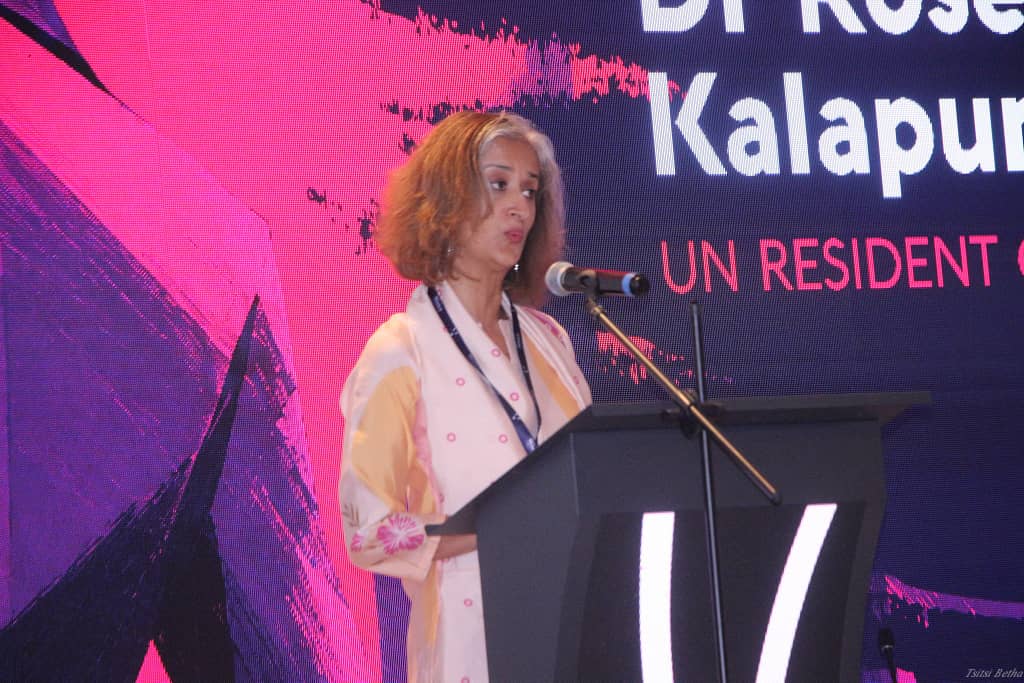
HARARE – Zimbabwe must remove institutional barriers that prevent women-owned businesses from accessing finance, markets and procurement opportunities instead of placing the burden on women to overcome these challenges, United Nations Resident Coordinator Dr Rosemary Kalapurakal has said.
Speaking at the Women Trade and Leadership Summit 2026 in Harare, Dr Kalapurakal said the country had considerable entrepreneurial potential but needed stronger pathways to help women-led enterprises grow, create jobs and compete in regional and international markets.
“Zimbabwe does not lack women entrepreneurs. What it lacks is pathways for them to grow their businesses,” she said.
Dr Kalapurakal, who has been in Zimbabwe for just over four months, described the country as one of immense possibility, with women already building businesses, developing products, employing people and entering markets despite persistent structural challenges.
Citing a UN Women study of nearly 600 women-owned businesses in Zimbabwe, she said 87 percent were micro-enterprises, 64 percent were unregistered and only two percent exported.
The figures, she said, illustrated the gap between women’s entrepreneurial participation and their ability to build competitive, sustainable businesses.
Rather than focusing exclusively on training women to navigate business challenges, Dr Kalapurakal urged institutions to examine whether their systems were fit for purpose.
“If finance is inaccessible, we teach women financial literacy. If markets are difficult to enter, we train them in market readiness. If procurement is complicated, we teach them to navigate procurement,” she said.
“But at some point, we have begun asking whether we are helping women navigate the barriers which should instead be removed.”
She challenged financial institutions to develop products suited to women-owned businesses, companies to open their supply chains through gender-responsive procurement, and trade organisations to make export systems more accessible.
Expanding access to finance and markets
Dr Kalapurakal said finance was essential but insufficient on its own. Women entrepreneurs also needed appropriate technology, business skills, standards, certification and market connections to turn capital into growth.
She called on financial institutions to establish measurable targets for financing women-owned businesses and design products around their operational realities. Companies, meanwhile, should expand procurement opportunities, while trade support organisations should connect entrepreneurs to trade finance, market information and potential buyers.
The African Continental Free Trade Area (AfCFTA) offers Zimbabwean women-owned businesses access to a wider continental market. However, Dr Kalapurakal said this opportunity would only translate into growth if businesses could meet standards, achieve scale, navigate trade requirements and connect with buyers.
Digital inclusion was equally important, she said, highlighting the need for affordable connectivity, digital skills, secure digital payments, e-commerce, renewable energy and climate-smart technologies.
The United Nations, she added, could help bridge these gaps by bringing together government, financial institutions, businesses, development partners and entrepreneurs to develop practical solutions.
As a trusted convener and policy advocate, the organisation can connect institutions, facilitate dialogue and draw on approaches that have worked elsewhere.
Women’s economic participation is an investment
Dr Kalapurakal said supporting women-owned businesses should be understood as an economic imperative rather than charity.
Women entrepreneurs contribute as producers, employers, taxpayers, innovators, traders and investors. When their businesses cannot grow, she argued, the economy loses productive capacity and opportunities for employment and investment.
“When their businesses are prevented from growing, what is effectively happening is that the economy is leaving productive capacity on the table,” she said.
“This support to women entrepreneurs is not charity. It’s economics.”
She also stressed that women’s economic participation depended on more than access to capital and markets. Freedom from violence, access to health services, control over their bodies and a fairer distribution of unpaid care work were essential to enabling women to build businesses and assume leadership roles.
Dr Kalapurakal pointed to progress within the United Nations, where women account for more than half of Resident Coordinators, attributing this to deliberate leadership decisions that prioritised gender equality.
The achievement, she said, demonstrated that equitable representation required institutions to make it a priority rather than simply assume progress would happen naturally.
She further challenged financial institutions, regulators and corporate leaders to strengthen women’s access to executive positions and boardrooms.
“It is not enough to bring women to the table. They must have the authority to shape the agenda,” she said.
UN commits to supporting women entrepreneurs
The United Nations, through its 25 agencies operating in Zimbabwe and the Resident Coordinator’s Office, remains committed to advancing inclusive economic development and expanding opportunities for women-owned businesses.
Dr Kalapurakal said the UN’s forthcoming cooperation programme with the Government of Zimbabwe for 2027 to 2031 would continue to support women’s access to formal finance, gender-responsive banking, inclusive innovation, health and agency.
Through the United Nations Development Programme, UN Women, the United Nations Population Fund and the International Trade Centre’s SheTrades Initiative, the organisation will also continue supporting women entrepreneurs to grow their businesses and compete in wider markets.
She urged summit participants to translate discussions into measurable results, including increased financing, more procurement contracts, expanded market access and the progression of businesses from micro to small enterprises and from informal to formal operations.
When stakeholders reconvene next year, she said, they should be able to demonstrate what had changed, who had benefited and whether women-owned businesses had gained meaningful access to economic opportunities.
Dr Kalapurakal thanked the summit organisers and partners, including the World Bank, national institutions, development partners and the private sector, for bringing stakeholders together.
She said the ultimate test of the summit would be whether it helped transform women’s entrepreneurial potential into measurable economic gains through more inclusive institutions, stronger business networks and practical pathways to finance and markets.


