
By Caroline Washaya-Moyo
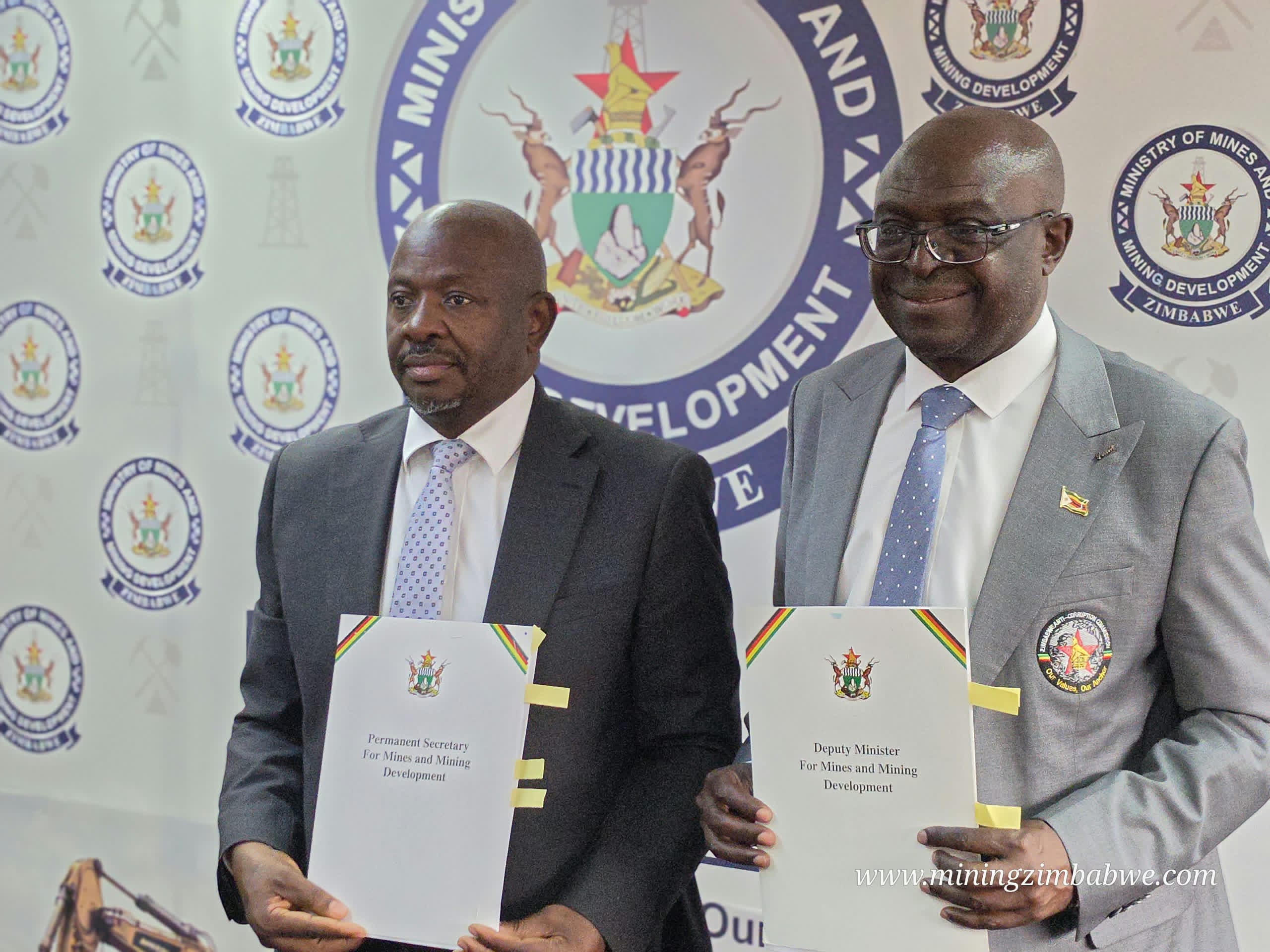
The Ministry of Mines and Mining Development and the Zimbabwe Anti-Corruption Commission (ZACC) have signed a Memorandum of Understanding (MOU) that will introduce practical measures to strengthen integrity in mining administration and protect the economic value of Zimbabwe’s mineral resources.
The agreement provides for joint action in four key areas—prevention, information sharing, technical training and implementation oversight—giving the two institutions a structured mechanism for addressing corruption risks within the mining sector.
Speaking at the signing ceremony, Permanent Secretary in the Ministry of Mines and Mining Development, Dr T U Wushe, said the partnership was important in protecting a sector that is central to Zimbabwe’s economic development.
“Today, we are not merely signing a document; we are forging a strategic alliance, a united front in our collective battle against corruption—a scourge that threatens the very foundations of our nation’s economic and social development,” he said.
Mining is a major source of export earnings, employment, Government revenue and investment. The administration of mining titles, inspections, compliance and royalty collection therefore has a direct impact on how much value Zimbabwe derives from its mineral wealth.
Under the MOU, Ministry officials, including provincial mining directors and inspectors, will participate in an Integrity Pledge programme. The Ministry will also conduct systems reviews and corruption-risk audits in areas identified as vulnerable.
The practical effect will be to identify weaknesses in mining administration and put measures in place to reduce opportunities for improper conduct before they result in losses or undermine confidence in the sector.
The agreement will also create a formal information-sharing and referral mechanism between the Ministry and ZACC.
This means that information relevant to suspected corruption can be exchanged through agreed channels, while allegations requiring investigation can be referred promptly to the appropriate authority rather than being handled through ad hoc arrangements.
Capacity building will form another important part of implementation.
The Ministry will provide ZACC officials with technical training on mining law, regulation and administration. In turn, ZACC will train Ministry personnel in anti-corruption methodologies.
The arrangement is intended to ensure that ZACC investigators have a better understanding of the technical mining environment, while mining officials are better equipped to identify, prevent and respond to corruption risks.
A Joint Steering Committee will oversee implementation of the agreement. The committee will monitor progress, identify challenges and assess whether the measures agreed upon are producing the intended results.
Dr Wushe said the partnership respected ZACC’s constitutional independence and was based on cooperation between institutions with complementary responsibilities.
“We recognise and fully respect your constitutional independence, which is vital for the effective execution of your mandate,” he said.
He also urged Ministry officials to regard the Integrity Pledge as a genuine commitment to ethical public service rather than a ceremonial requirement.
“The Integrity Pledge we will take is not a mere formality; it is a solemn vow to serve our nation with honour and to be steadfast in our duty,” he said.
The expected benefits extend beyond institutional cooperation. Stronger controls around mining administration can help improve the predictability of regulatory processes, support fair competition among operators and protect revenue due to the State.
This is particularly important as Zimbabwe seeks to maximise returns from its mineral endowment and attract investment into a sector with significant potential to contribute to economic growth.
Dr Wushe said the ultimate objective was to create a mining sector in which opportunities were determined by merit and compliance rather than illicit dealings.
“The mining sector is not, and will not be, a safe haven for corruption. We are building a system defined by integrity, where opportunity is driven by merit and compliance, not by illicit deals,” he said.
The effectiveness of the MOU will ultimately depend on implementation. Its practical test will be whether risk audits are conducted, officials are trained, referrals are acted upon, information is shared effectively and the Joint Steering Committee regularly tracks progress.
If these measures are consistently implemented, the partnership could strengthen the credibility of mining administration while helping ensure that more of the value generated from Zimbabwe’s mineral resources reaches the national economy and contributes to development.